
THE GENESIS OF NUŠIĆ’S LOVE FOR THE THEATRE
THE GENESIS OF NUŠIĆ’S LOVE FOR THE THEATRE
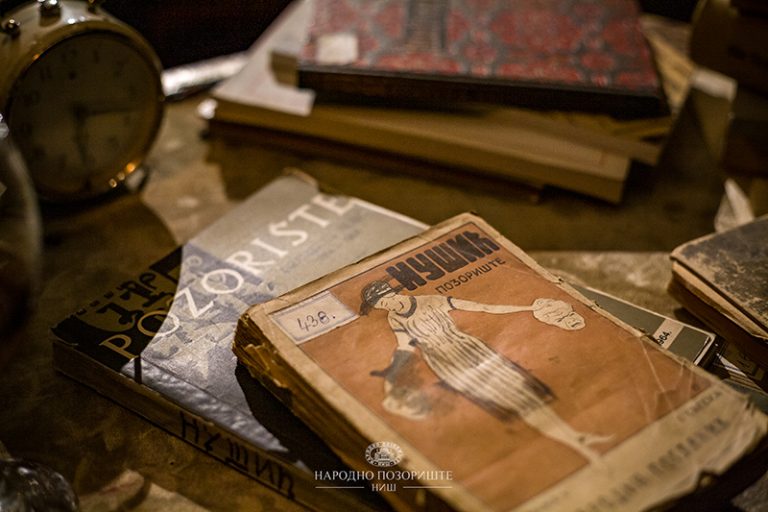
Dear Mr. Editor,
You have asked me when and how my love for the theatre began, to which I devoted a full forty years of my work. I will gladly answer you, all the more so because you are asking me only this one question.
I attended primary school and two years of secondary school in Smederevo, where I also spent my earliest childhood. At that time, Smederevo, being the only export port, was an unusually prosperous and lively place, and travelling theatre companies would often visit the town. When they left, we children would, as is often still the case today, stage our own plays in sheds.
One of those companies had a particular influence on me.
This was shortly before the Herzegovina Uprising. I was barely twelve years old, still in the first years of secondary school. A theatre company arrived in Smederevo, led by the then-famous Mihajlo Dimić, the son-in-law of Joksim Nović Otočanin, who was said to be the finest Kir Janja. Dimić was the true embodiment of the travelling actors of the previous century. He always wore a black frock coat that fell below his knees, a Vatermörder collar around his neck, and he was unshaven, with long, artistic hair. On his head he wore a top hat from the theatre wardrobe, and on his feet were worn-out shoes. Thin and emaciated, yet proud of his calling and sensitive about his artistic reputation.
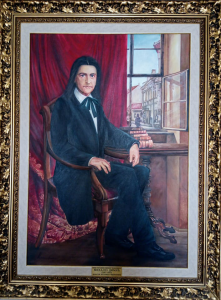
Artwork: Katarina Filipović
National Theatre in Niš
The company performed near my house, in the garden by the “Zeleni Venac,” and most of the props were borrowed from my family home. For me, it was a great honour and a source of pride whenever he would put some chair on my head and carry it from our house to the theatre and back again the next day. Many children envied me these honours. Needless to say, for the services that my family and I provided to the company, I was allowed to watch every performance free of charge, standing right beside the stage, where the Gypsies played their music. As I was small in stature, I could just about reach the stage with my eyes and nose, so I can say that on that occasion I literally smelled the stage for the first time.
But I also experienced a rare privilege, one denied to most other mortal children: from time to time I was allowed behind the scenes, where I could see with my own eyes how the scenery was set up, how the actors were made up, and how they glued beards and moustaches onto their faces. All of this later proved extremely useful in the theatre games we children played, and, above all, it gave me authority, so I was always the director of those little theatres.
The Mihajlo Dimić company mostly performed patriotic plays: Hajduk Veljko, The Battle of Kosovo, The Cross and the Crown, The Death of Stefan Dečanski, The Two Sergeants, along with the occasional play by Sterija. At that time, an uprising was already being anticipated in Bosnia and Herzegovina, and a patriotic spirit and warlike mood had swept through Šumadija as well. The director of a travelling theatre therefore had to adapt to that mood. Dimić even wrote several patriotic plays himself, which appealed to the general sentiment of the audience.
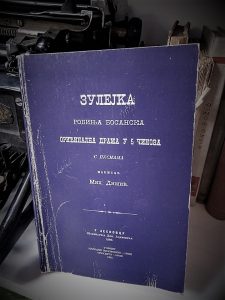
First phototypical edition, 1992, based on the 1889 edition
National Theatre in Niš
The leading roles in those plays were usually performed by the then young actor Mihajlo Risantijević, who later became head of the extras at the Belgrade Theatre. Clumsy even then, as he remained later in life, and speaking in that milkman’s dialect which he stubbornly used until his death, he made an extraordinary impression on us children, as well as on a large part of the audience, simply through his appearance.
When, in the third act of Hajduk Veljko, Veljko would storm into the Turkish camp, Risantijević would charge like a bear, cross the stage in two strides, and the young boys playing the Turks—who were a full metre shorter than Risantijević—would tumble across the stage like cucumbers poured out of a sack. The audience would then erupt in indescribable enthusiasm and sincerely marvel at Risantijević’s heroism.
When I remember how respectfully I watched Risantijević whenever he passed by my house! I could never have imagined then that one day, while appearing as an extra at the Belgrade Theatre, I would come under his management, much less that one day I would become his director.
When the uprising in Bosnia had already broken out and people here had begun whispering more and more about the possibility of Serbia entering the war, people began tightening their belts, holding on to their money and saving wherever they could. Dimić’s company therefore fell on hard times—such hard times that he did not even have enough money to transport the company from Smederevo to Jagodina, which at the time was not a particularly great expense.
One day, Dimić came to my father. I do not know exactly what happened, but I remember that that afternoon Stevan Dečanski, Hajduk Veljko, Tsar Lazar and the other Serbian heroes, each carrying a piece of scenery on his head like a halva seller carrying a tray of halva, came to our house and left the scenery in the shed. Later I understood that Dimić had borrowed money from my father for the journey and had left the scenery and the main curtain as collateral. Needless to say, he never came back for them.
In this way, I became the owner of genuine theatre scenery. On one side was a painted room, which served both as Kir Janja’s room and as the ceremonial hall of Tsar Lazar; on the other, painted across wooden slats, was a forest that served equally well as a forest, a dungeon and a street.
One can imagine how much I impressed the other children as the owner of genuine theatre scenery, and one can imagine how many advantages my theatre now had, with its authentic scenery.
And so, that was when a higher, rather than merely childish, love for the theatre was born within me. I began writing plays myself, which I performed together with my friends. And, interestingly enough, despite the patriotic mood that prevailed at the time, the first play I wrote, when I was not yet twelve years old, was a comedy. I remember that it was a humorous piece about family life and that it was called The Red Beard.
There you have it, then—my marriage to the stage, or, if you prefer, the genesis of my love for the theatre.
That was a full fifty years ago.
Branislav Nušić
Text prepared by: Tamara Milosavljević