
ABOUT THEATRE
ABOUT THEATRE
Niš is one of the first cities to enter the history of Serbian theatre. The first known theatrical event was recorded in 1883 on a poster for one of the productions of the travelling company, which was performed on the occasion of the marriage anniversary of King Milan and Queen Natalija Obrenović.
By merging the theatre companies of D. Jovanović and M. Dimić at the beginning of 1887, Sinđelić Theatre was founded. The inaugural production was Serbian Hajduks by J. Sterija Popović on 11th of March, 1887 at Knez Mihajlo Inn.
Sinđelić Theatre was founded at the initiative of Stevan Sremac – a professor from Niš, Milorad Petrović – a teacher, Stevan Nikšić – Lala, Heinrich Liller and Špira Klarik. Mihajlo Dimić was the first manager. The following plays were performed: The Taming of the Shrew, The Misanthrope, Two Pennies, and The Hoax.
In the period between 1890 and 1900, Sinđelić Theatre entered the second stage of development at the time of great conflicts of political parties in the last decade of the rule of Obrenović Dynasty. The productions were performed at Europe Inn. In 1892 the theatre was closed. In 1893, Sinđelić Theater in Niš was finally founded. At that time, Niš had become the third biggest Serbian metropolis.
Although it was constantly talked about the need to construct a theatre building, Sinđelić still gave performances at inns: Europe, The Crown, garden Macedonia, Paris; later on at the so-called Green Gymnasium, and Boulevard. In 1906, the Russian Tzar was built. After a two-year absence, Niš got the theatre again under the management of Kosta Delini (1904-1912).
In 1915, it was shut down. Between 1921 and 1929 it barely survived as an improvised theatre. The efforts of Branislav Nušić and the Association of Actors led to the merger of companies “Sinđelić” and “Gundulić” in 1921. The new theatre was named Privileged City Theatre. In 1922, at the meeting of the Niš Municipality and at the suggestion of Dragiša Cvetković, the land was allocated for the construction of a theatre building. In the period between 1929 and 1930, the theatre was known as Morava Banovina Theatre. There were 400 seats at The Craft House.
In 1931, the theatre opened a season in Niš with the production of a play „The Death of the Mother of the Jugović“. For seven years the theatre operated in the Craft House. In 1936 a production was transmitted via the Belgrade radio for the first time – it was the second act of Stevan Sremac’s play „Zona Zamfirova“ by Sima Bunić.
On January 1st, 1939, in a newly-built building at Sinđelić Square, the first theatre production “The Building of Ravanica” or “The Endowment of Emperor Lazar” directed by Dragoslav Kandić was performed. The theatre had 687 seats. The first major renovation of the theatre building took place in 1968; the second in 1986; and the third in 2002/2003.
1887
year of establishment
10.000+
performance
6 million+
viewers
National Theatre Through Video
HISTORY
Sinđelić Theatre, one of the oldest Serbian theatres, was founded on March 11th, 1887. Milorad Petrović, a teacher in Sićevo, a military official Đoka Protić and Stevan Nikšić Lala were among the founders. Mihailo Dimić was the manager. The first production, Serbian Hajduks /Serbian Guerrilla Fighters/ by Jovan Sterija Popović, was performed on March 11th, 1887 in the hall of the tavern “Europe”.
After the break in 1890, the Theatre continued its work on January 26th, 1891 with the performance of a musical choir adaptation and one-act play A Cup of Tea by a French writer V. Droste. As early as 1892 Sinđelić Theatre was closed again, and on July 24th, 1893 it was reopened with the production Love Can Do Anything (a funny four-act play, a German-Yugoslav adaptation of Shakespeare’s comedy The Taming of the Shrew).
The same year, when Aleksandar Milojević, an actor and a director, became the manager, ended the first stage of this theatre’s operation, the period of national, folklore and mythicized heroics. The time of modernization and transformation lasted until 1900. With great actors, such as Dobrica Milutinović, Olga Ilić, Bogoboj Rucović, Sofija Haritonović and Ilija Stanojević Čiča, “Sinđelić” became a branch of the Royal Serbian National Theatre in Belgrade under the protection of Queen Draga. Between 1900 and 1905, the theatre operated as a travelling theatre.
The repertoire included plays such as The White Horse Inn, The Courier of Lyon, The Eleventh Commandment, The Bohemian Life, Koštana, The Upstart, Mamzelle Nitouche, Đurađ Branković, Mr. Chief, The Two Orphans and others.
The Law on the National Theatre in Belgrade (1911) and the Regulation on the Travelling Companies (1912) established five travelling theatres bearing the names of Serbian playwrights and actors. “Sinđelić” became a travelling theatre for the southeast region based in Niš and changed its name to Privileged Travelling Theatre “Trifković”.
The management of the theatre was entrusted to Sima Bunić. “Trifković” operated until July 1914 when it changed its name to “Sinđelić” again and the manager (for the second time) was Aleksandar Milojević until October 18th, 1915 when the actors went to war and exile. The theatre reopened at the end of 1918. The repertoire included plays such as The Hoax, Đido, Girl’s Curse, Zona Zamfirova, Ivko’s Feast, Koštana, Old Corporal and others. On August 23rd “Sinđelić” merged with “Gundulić” theatre company from Zaječar and grew into Niš Privileged Theatre or Privileged City Theatre and the manager was Ljubomir Rajičić Čvrga.
Until 1921 the productions were performed in the Russian Tzar Inn. The theatre was closed due to financial problems in 1929. As of 1930, the members of the ensemble performed in “Morava Banovina Theatre”.
THE BUILDING
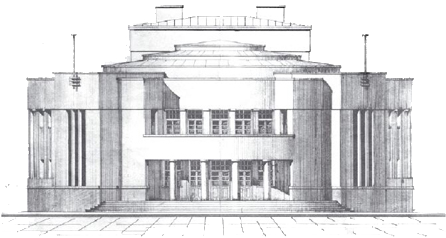
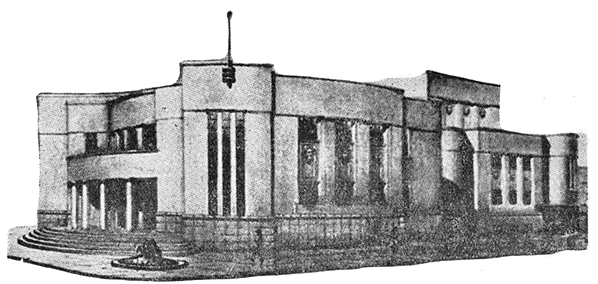
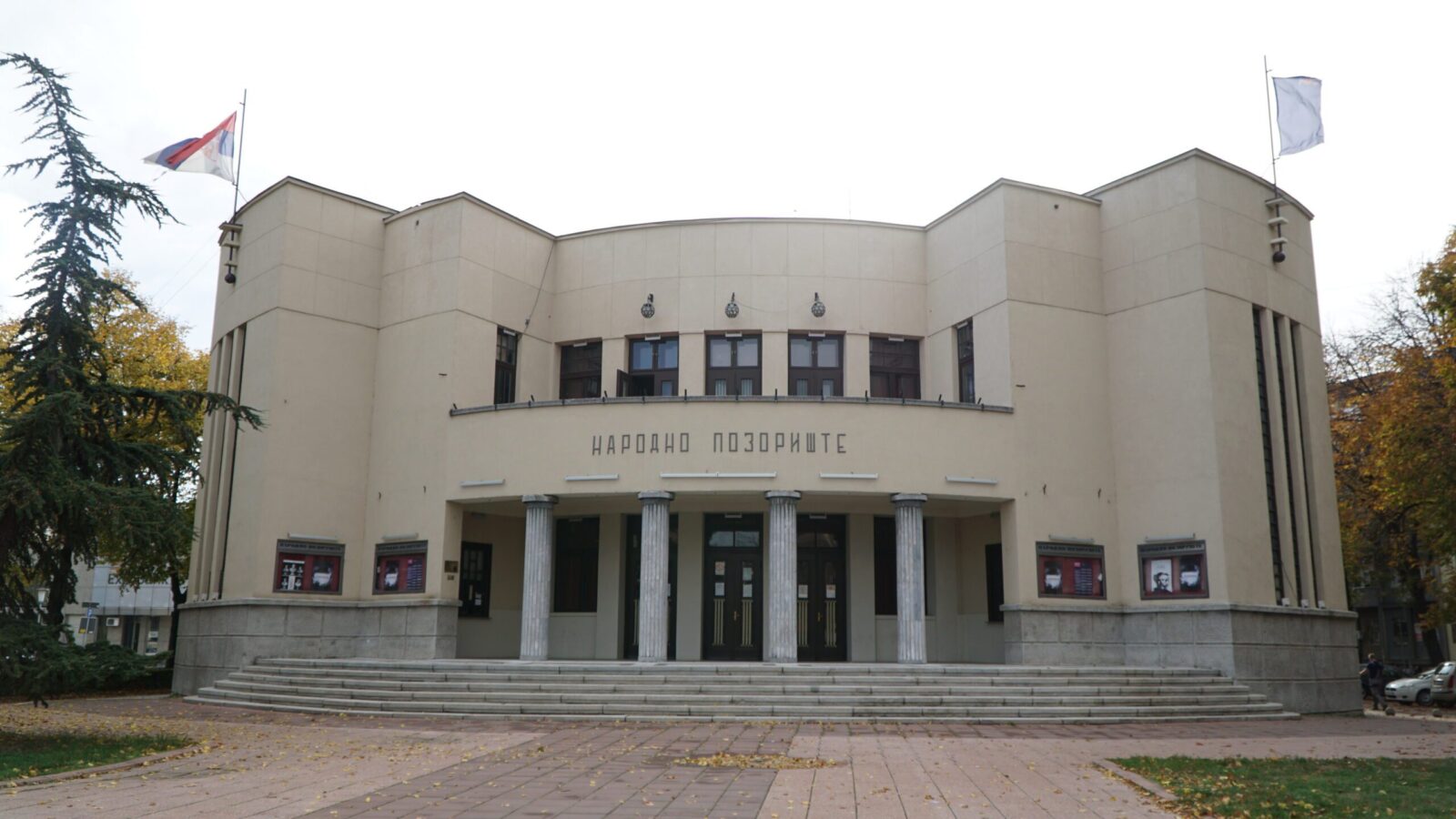
The building of the National Theatre at Sinđelić Square was built in 1939 for the Theatre of Morava Banovina. The initiative for the construction of a new theatre building came from Marko Novaković, the Ban of Morava Banovina at the time. The project, completed on the 50th anniversary of Sinđelić Theatre, was constructed by Vsevolod Tatarinov, an architect from Niš of Russian origin. The foundation stone was laid on 27th of June 1937, and the theatre was opened on 1st of January, 1939 with the play The Building of Ravanica by Milorad Šapčanin.
The building is impressive and measures 54 x 34 m, designed in a modern style. The main entrance with a semicircular staircase and a covered landing, under the upstairs balcony, and held by four pillars, is oriented towards the ceremonial plateau at the expansion of the square towards Vožd Karađorđe St. Side and technical entrances are on the east and west side of the building. From the back of the theatre, there is a wide ramp for bringing in the theatre scenery.
The theater has an amphitheater hall with 390 seats in the stalls, a balcony with 156 seats and four boxes with six seats at the level of the stage (two on the left, two on the right) and two on the first floor, two central foyers on the ground floor and upstairs with the hall and wardrobes. In front of a large, mobile stage, measuring 14 x 10 m, with a tower ramp for lifting the scenes, installed according to the technological project of the engineer Velja Jovanović, the technical manager of the National Theater in Belgrade, there is a recess for the orchestra, and another stage (technical) behind it, behind which there is a hall for scenery with a direct exit towards the ramp.
The additions to the National Theatre Building were constructed in 1946 in accordance with the project by Aleksandar Medvedev, an architect from Niš of Russian origin. Above the existing wardrobes on the ground floor, on both lateral sides of the theatre, a floor with rooms where costumes are stored was added. Above the back stage space there is a rehearsal room, a club, a reading room and painting workshop. The building addition from 1946 was carried out in accordance with the basic project. Later adaptations (2007) included only interior and technological improvements.