
TRAVELLING TROUPE ŠOPALOVIĆ
drama
Ljubomir Simović
DIRECTOR’S BIOGRAPHY
Tatjana Mandić Rigonat is a theatre director.
She graduated in theatre and radio directing from the Faculty of Dramatic Arts in Belgrade, in the class of Professor Dejan Mijač.
She has directed numerous productions based on works by contemporary writers and classical authors, and has adapted the following novels for the stage: Lolita by V. Nabokov, Dead Souls by N. V. Gogol, Demons by F. M. Dostoevsky, and God Grant That Your Mother Gives Birth to You by V. Rudan.
She has published two collections of poetry: The Mystery of the Happy Double Bass and From the Life of Birds.
Nine of her productions are currently part of the theatre repertoire in Belgrade. At the National Theatre in Belgrade, she directed Demons by F. M. Dostoevsky, Ivanov by A. P. Chekhov, The Sexual Neuroses of Our Parents by L. Barfuss, Our Sons by W. J. Maramboy, and The Balkan Spy by D. Kovačević.
At the Vuk Cultural Centre, her productions based on works by contemporary Russian playwrights are currently on the repertoire: Illusions by I. Vyrypaev and The Hollow Stone by N. Kolyada.
At the Boško Buha Theatre, she directed The Minister’s Wife by B. Nušić and Sleeping Beauty by M. Depolo.
She is a permanent member of the Drama ensemble of the National Theatre in Belgrade.
DIRECTOR’S NOTE
“The task of theatre is to make things impossible.”
Heiner Müller
In an age of realized dystopia, any artistic act carries an initiatory dimension of humanization. And theatre above all! Theatre has always been a living encounter between one human being and another, and even when things are at their worst or most banal, it is still an encounter.
Thirty-four years have passed since the premiere of The Travelling Theatre Šopalović in 1985 at the Yugoslav Drama Theatre, directed by Dejan Mijač, my professor. Those years have been marked by new wars, black flags, crimes, the collapse of Yugoslavia, demonstrations, artists’ protests, and the question has often been asked: when is the time for theatre, and when is it not? Is there ever a time when it is ethical for theatre to renounce itself, and what does such renunciation mean, and whom does it serve?
In The Travelling Theatre Šopalović by Ljubomir Simović, for me the most beautiful play in which theatre itself is the main character, a drama steeped in the poetry of essence, questions of a metaphysical, ontological, epistemological, ethical and aesthetic nature are raised. All of them concern the nature of theatrical art, the relationship between theatre and life, and the phenomenon of acting. The play possesses an initiatory power and beauty. The world of Simović’s metaphors is subversive in today’s age of noise, anger, slogans, and impoverished language, thought and speech.
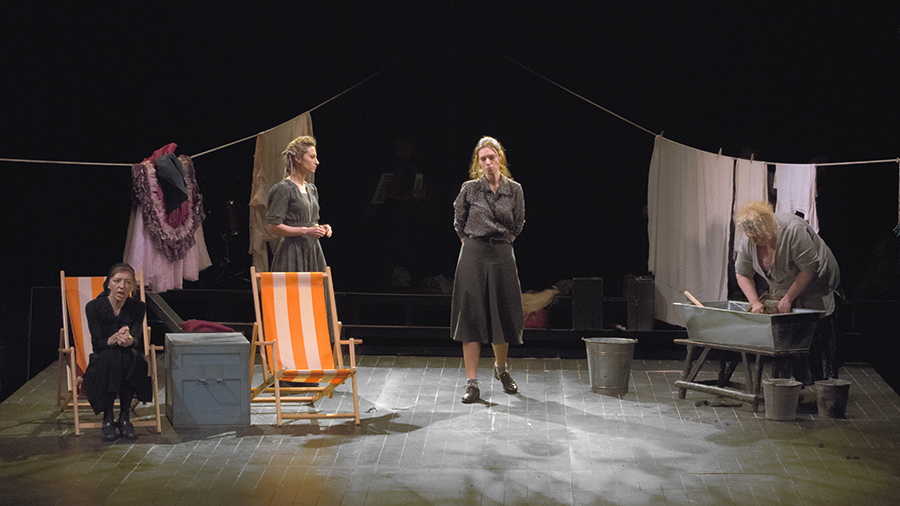
I sought a stage form for Simović’s poetic and philosophical ocean of beauty, humour and tragedy, without reducing the play. I added the poems The Occupation of Užice, A European Night in Užice, In Line Before the Cauldron of the Public Soup Kitchen at Carina, and The Gallows at the Grain Market in Užice. I transformed some of the lines into verse and set the metatheatrical dimension of the stage story in motion beneath the outstretched wings of a steel eagle, whose claws hold both a swastika and a full moon, an eagle that has spread its wings over the boards that signify life.
The whole world is a stage. On that stage of the world, we play roles of which we are conscious. We also play those of which we are unaware, guided by an inner script, described by Eric Berne in his now-famous book What Game Are You Playing? We live in a time of new forms of totalitarianism and unfreedom. In such a time, for me the fundamental question is not whether to perform plays, but what to perform and how to perform it. I was interested in the relationship between beauty and evil, how evil is born, what power beauty possesses, the relationship between beauty and freedom, and whether there is a boundary between theatre and life. What happens when the bloody theatre of life, beneath the shadow of gallows and black flags in occupied Užice, collides with the world of four actors from a travelling theatre?
In Simović’s drama, just as in Dostoevsky, it is beauty that saves the world, that possesses the power to transform, to lead to self-knowledge, and to bring a criminal to repentance. The actor Filip Trnavac says: “I cannot enter reality and take part in it on my own! I can enter it only with all of my art, the art to which I belong!” With this position, he resolves the dichotomy between life and art. The artist suffers, but saves life; he changes the course of events, changes the world when he raises high the sword of the art to which he belongs with his whole soul, without reservation. This conviction of the indivisibility of being, of merging the artistic and the lived act into one, is a feat of poetry—a poetry that the world recognizes as madness because it transcends reason.
Irena Popović (1974), composer
She graduated from the Faculty of Music in Belgrade, Department of Composition, and completed her master’s studies in Salzburg at the Mozarteum University, Department of Composition and Orchestration.
Applied music holds an important place in her body of work, which she composes for theatres throughout Europe. She collaborates with some of the region’s most prominent directors (O. Frljić, A. Urban, K. Mladenović, S. Trišić, T. M. Rigonat, S. Unkovski).
She is the recipient of numerous awards: two Sterija Awards, two awards at the International Small Scene Theatre Festival in Rijeka, two awards at the Festival of Professional Theatres of Vojvodina, an award for Best Music at the Theatre/Kazalište Encounters in Bosnia and Herzegovina (Brčko District), a Special Award for Music at the Days of Comedy Festival in Jagodina and at the Yugoslav Theatre Festival in Užice, an award for Best Music at the Theatre Spring Festival in Šabac, at the Antalya Film Festival, and many others.
Her compositions are performed at festivals around the world, while her works are part of the repertoires of numerous soloists and chamber ensembles.
She is the founder of the artistic group Prerađivačka industrija muzičkog materijala (Processing Industry of Musical Material) and the women’s vocal art collective Oh, meine liebe Constanze, which operates in diverse spaces and brings together different forms of artistic expression.
She lives in Belgrade and dreams of the sea.
Stefan Savković, Costume Designer
He graduated from the Faculty of Applied Arts in Belgrade, in the class of Professor Milanka Buca Berberović. He works as a costume designer in theatre, film, television and advertising production.
He has designed costumes for more than 20 theatre productions (Your Powerful Weapon Against My Unruly Cellulite, The Nineties, Ivanov, Under the Millstone, The Hen, Constantine, The Wrath of God, Cleaning the Idiot, Antigone, The Marriage of Figaro); he has worked as a costume designer and assistant costume designer on films including White Crow, Unlocked, Fallen Angel, The November Man, Secretly, The Parade, Zone of the Dead, Comrade Black in the NOB, as well as on several television series: Nemanjići – The Birth of the Kingdom, Blind Man’s Bluff, Comrade Black in the NOB, Marco Polo, Titanic: Blood and Steel.
He is the recipient of the Sterija Award for Costume Design for the production Constantine, as well as several awards at the Deltić Festić and Zvezdarište festivals.
Dunja Kostić (1991, Belgrade), Set Designer
She completed her undergraduate and master’s studies at the Faculty of Applied Arts in Belgrade, in the class of Professor Geroslav Zarić.
During her three-year engagement at the National Theatre in Belgrade, she collaborated with renowned artists (T. M. Rigonat, B. Hojnik, I. D. Maričić, A. Grigorović, I. V. Torbica, J. Lorenci, A. Ilić, A. Nikolić, I. Milošević, M. Jevtić, G. Stojanović) on numerous projects, including Ivanov, The Kingdom of Darkness, The Heavenly Kingdom, Electra, Balkan Spy, and others.
She has also designed sets for the international festival Balkan Dance Project, New Year’s and closing gala concerts of the National Theatre, concerts and public performances of the Opera Studio, the opening ceremony of the International Geography Olympiad, as well as numerous other events.
Miodrag Krčmarik (1975, Vlasotince)
He graduated in Acting from the Faculty of Arts of the University of Pristina, in the class of Professor Božidar Dimitrijević. He is an Associate Professor of Stage Movement at the same faculty, where he also teaches acrobatics and stage combat.
He furthered his training at workshops led by students of Marcel Marceau. He has created stage movement for more than forty theatre productions. He has performed in numerous theatre, film and television roles. He has participated in international theatre projects and served on the juries of several festivals.
When is this performance playing?
You can find all upcoming dates on the Repertoire page.
BASIC INFORMATION
Genre
drama
Age
14+
Premiere
March 11, 2019
Stage
Main Stage
CREATIVE TEAM
Playwright
Ljubomir Simović
Direction, Dramaturgy
Tatjana Mandić Rigonat
Composer
Irena Popović
Costume Designer
Stefan Savković
Set Designer
Dunja Kostić
Stage Movement
Miodrag Krčmarik
Language Editor
Nataša Ilić
Production Coordinator
Ana Veljković
Piano Accompaniment
Silvija Nešić / Mila Pužić
CHARACTERS
Occupiers
MAJCEN
Aleksandar Krstić
MILUN
Marjan Todorović
DROBAC
Aleksandar Marinković
Citizens of Užice
BLAGOJE BABIĆ
Aleksandar Mihailović
GINA
Jasminka Hodžić
SIMKA
Maja Vukojević Cvetković
WOMEN CITIZENS, DARA, TOMANIJA
Evgenija Stanković, Katarina Mitić Pavlović, Katarina Arsić
Actors of the Šopalović Travelling Theatre
VASIILIJE ŠOPALOVIĆ
Dejan Cicmilović
JELISAVETA PROTIĆ
Sanja Krstović
FILIP TRNAVAC
Miloš Cvetković
SOFIJA SUBOTIĆ
Jelisaveta Koraksić
TECHNICAL CREW
Head of Technical Department
Ljubiša Živković
Stage Manager
Dobrila Marjanović
Prompt
Ozren Mitić
Sound Engineer
Slobodan Ilić
Lighting Design
Dejan Mitić
Lighting Technician
Nemanja Pavlović
Stage Technician
Slaviša Filipović
Set Builders
Radomir Pešić, Dragan Dinić, Radovan Živković, Marin Rajić, Mića Lazarević, Miodrag Đorđević
Props
Dragan Nikolić, Marko Đorđević
Wardrobe
Dušica Mladenović, Marko Dinić
Makeup Artists, Wig Makers
Ljiljana Rašić, Marija Pešić, Ivana Lazarević
Tailoring
Marina Stevanović, Vladimir Pekić
Painting
Katarina Filipović
Workshop
Bogoljub Đorđević, Goran Stanković, Dragan Perić, Branislav Nikolić
Procurement
Zoran Denčić
Driver
Nebojša Šarčević