
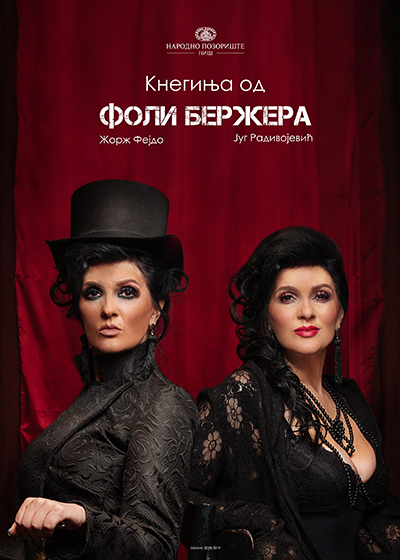
THE DUCHESS OF THE FOLIES BERGERES
drama
Georges Feydeau
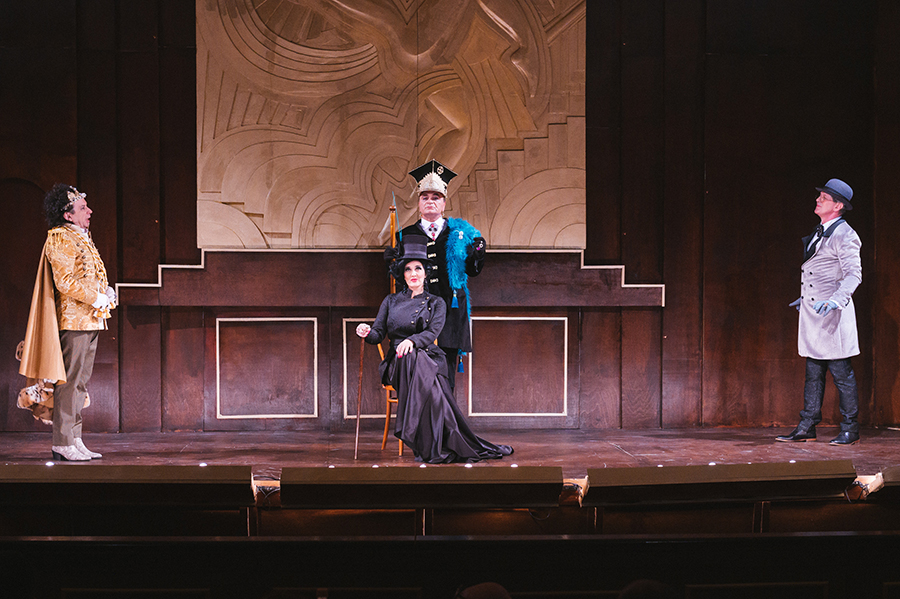
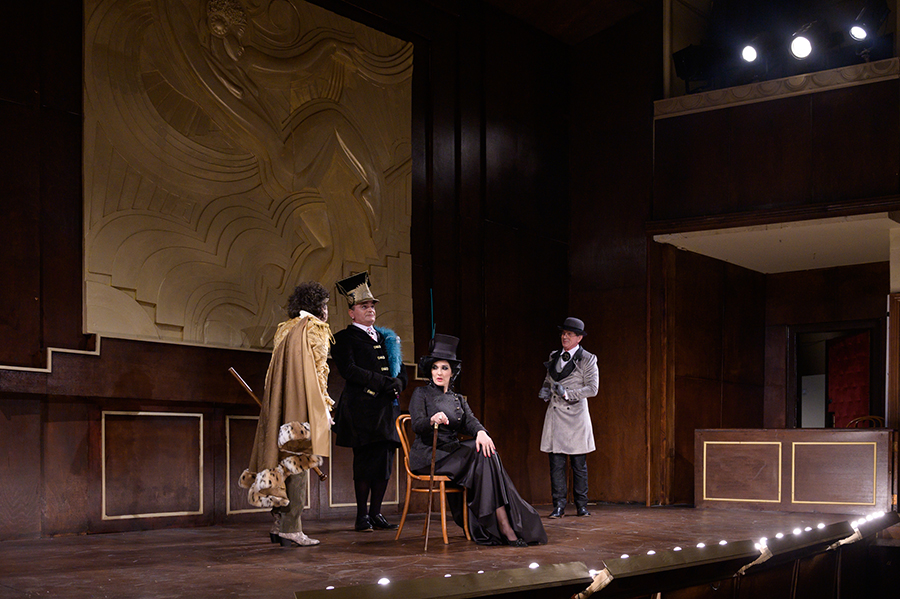
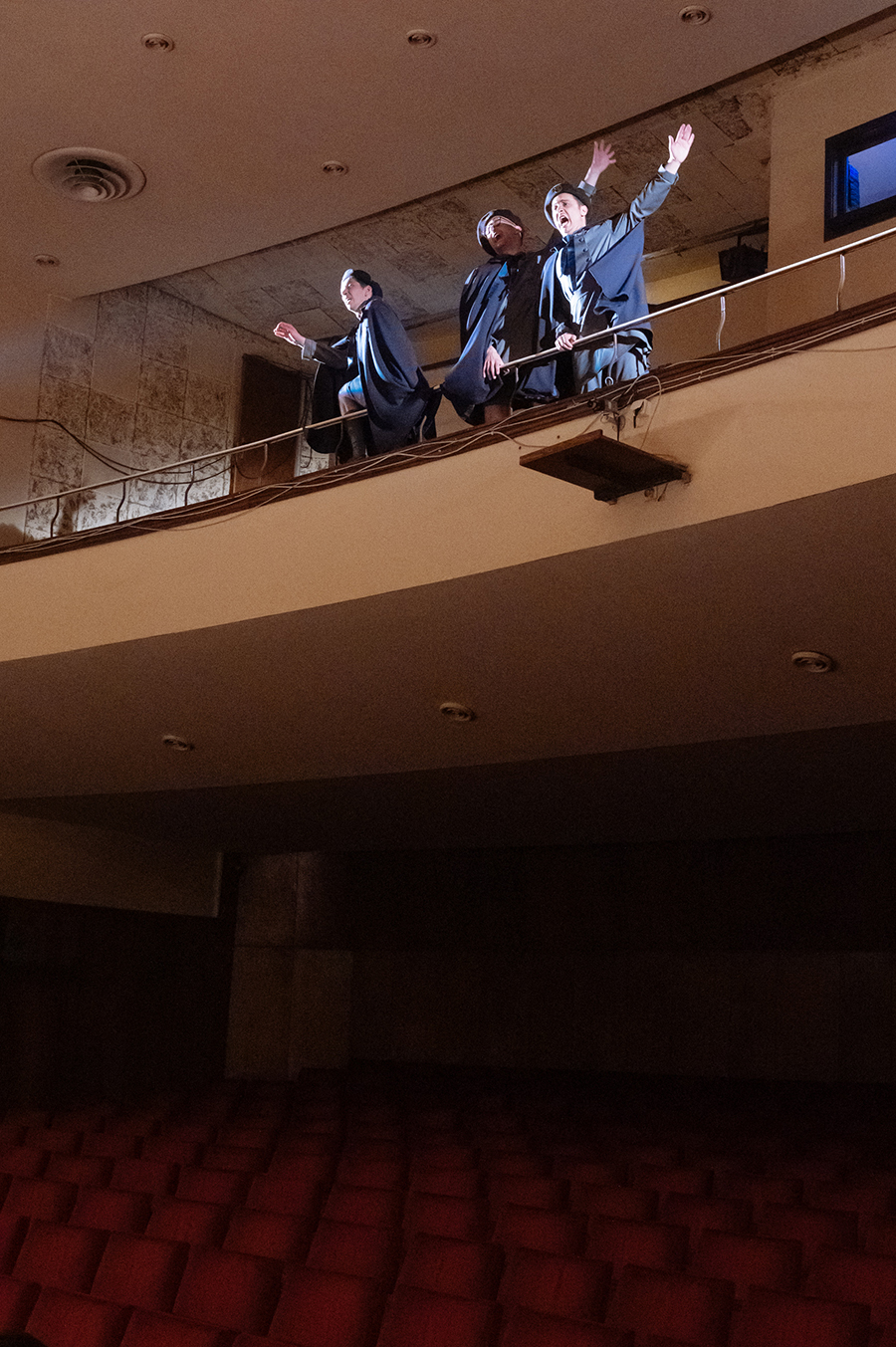
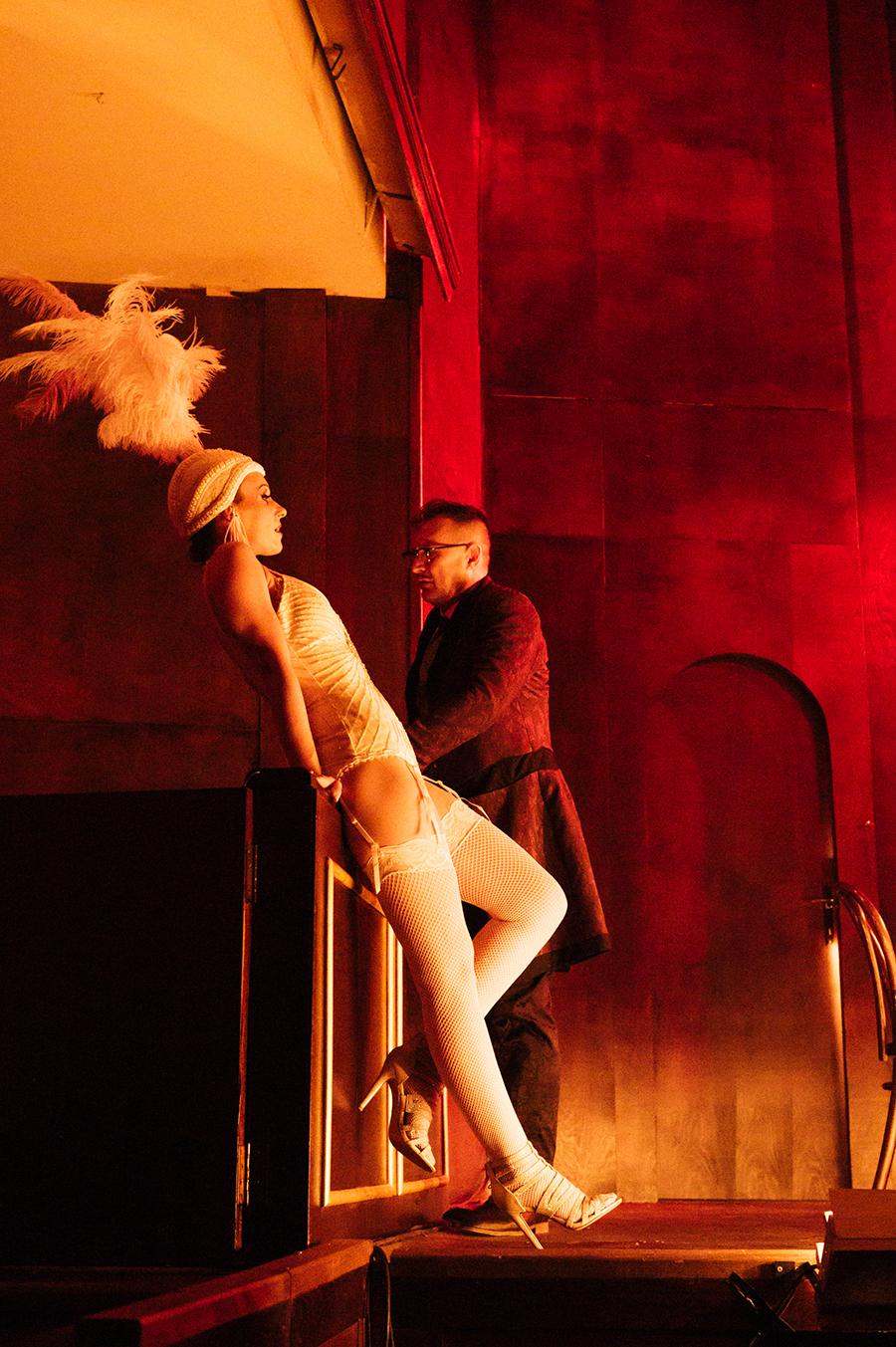
The hilarious comedy by the renowned Georges Feydeau will easily draw the audience into a witty story full of incredible twists and unexpected turns.
The adventures of a charming and cunning Parisian beauty who, by a fortunate twist of fate, becomes a princess but cannot resist the call of her former life, and her naive and unsuspecting cuckolded husband, will have audiences laughing to tears and thoroughly entertained.
ABOUT THE PLAYWRIGHT
Georges Feydeau (1862–1921) was a French playwright and one of the most important authors of farce, earning him the enduring title of the “King of Vaudeville.”
He began writing at a very young age, initially composing dramatic monologues. At the age of twenty, he wrote his first play, “Through the Window.” His first major theatrical success came with “Tailor for Ladies,” which he wrote at the age of twenty-four.
He achieved international fame in 1892 with the comedies “Monsieur chasse!” and “Champignol malgré lui.” A series of major successes followed, including “Hotel Paradiso,” “Sauce,” “The Turkey,” “The Girl from Maxim’s,” “A Flea in Her Ear,” “Give Me Your Wife,” and “Don’t Walk Around Naked.”
Feydeau’s plays have been performed on the world’s most prestigious stages and remain part of theatre repertoires around the globe to this day.
He died in Paris in 1921 and was buried at Montmartre Cemetery.
DIRECTOR’S BIOGRAPHY
Jug Radivojević was born on March 1, 1972, in Belgrade. He completed primary school and secondary school in Vranje, where he also began his theatre career at the “Bora Stanković” Theatre, alongside his father, a theatre manager, director and actor, and his mother, an actress.
He graduated in Theatre Directing from the Faculty of Dramatic Arts in Belgrade, with “Koštana” by Bora Stanković, performed at the Yugoslav Drama Theatre, as his graduation production.
To date, he has directed more than 100 productions at theatres throughout Serbia and the region and has received more than 50 of the most prestigious awards in Serbia and abroad.
In addition to theatre, he has successfully worked as a film and television director. He was a resident director at the Yugoslav Drama Theatre and an assistant professor at the Faculty of Dramatic Arts in Belgrade, at the Department of Acting.
He is currently a resident director of the Drama Company of the National Theatre in Belgrade, Chairman of the Board of BITEF, a member of the Board of Directors of FK “Crvena zvezda”, and President of the Red Star Foundation.
He has served as Vice President of the Social Democratic Party of Serbia (SDPS) since its founding.
He is married to actress Milena Vasić and is the father of two sons, Vuk and Lav.
Henri Gidel
FEYDEAU AND THE THEATRE OF THE ABSURD*
…As early as 1938, Paul Achard hailed Feydeau as an inspiration for the absurd (loufoque) in theatre and film. Robert Kemp, for his part, saw in The Girl from Maxim’s “a farce whose inventiveness would not be surpassed by Parade, The Married Couple at the Eiffel Tower, or The Breasts of Tiresias.” For others, “Feydeau’s work represents one of the sources of Dada theatre.” Antonin Artaud himself, as early as 1930, mentions Feydeau among those who influenced the theatre of Alfred Jarry, which he founded together with Roger Vitrac. After the Second World War, there was a renewed interest in the Surrealism and avant-garde of the 1930s, and subsequently, even more strongly, in the Theatre of the Absurd of the 1950s, particularly Ionesco. This was discussed, for example, by Henri Jeanson and Bertrand Poirot-Delpech, as well as by one of the co-authors of a recently published history of contemporary literature. Ionesco himself acknowledged that there was a “great similarity” between Feydeau’s work and his own.
Indeed, there are a number of parallels between Feydeau’s theatre and the Theatre of the Absurd. The first can be found in the fundamental philosophical premise underlying both: in both cases, the human condition is essentially viewed pessimistically; man is often merely a marionette, a plaything of unfathomable circumstances and foolish fatality. There is no particular belief or ideal to guide or comfort him. All his efforts, doomed to failure from the outset, prove completely futile. Let us recall how, at the end of Beckett’s Waiting for Godot, the characters find themselves in exactly the same position as at the beginning of the play; is this not also the case with most of Feydeau’s characters, eternal fools caught in the same farce? Likewise, those wretched couples we encounter in Beckett or Ionesco correspond to the families torn apart by senseless quarrels in Feydeau’s later one-act plays. Beneath the surface gaiety that initially distinguishes Feydeau’s world from that of modern theatre lies, in fact, the same absence of illusions, the same scepticism, the same relentless vision of the human condition.
Despite the comparisons we have drawn, some of them particularly striking, it is nevertheless clear that Feydeau’s work is deeply rooted in tradition in many respects. Unlike most avant-garde dramatists, he respects established dramatic categories: the time and place in which the story unfolds are precisely defined; the carefully constructed plot contains an exposition, a complication and a resolution. Even when his characters are sometimes “two-dimensional,” the author nevertheless situates them socially and meticulously defines their contours. Moreover, it is difficult to discern in his work any traces of Symbolist or metaphysical ambitions. His sole aim is to provoke laughter. Of course, farce and unruliness are frequent in Feydeau, but unlike in the New Theatre, they do not form part of the very definition of his theatre: Feydeau does not begin with the absurd; he arrives at it. In his plays, extravagance marks out and embellishes the path along which the audience is firmly guided. When Ionesco transforms his characters into rhinoceroses, he offers us no explanation for this bizarreness; but when Feydeau, as we have seen, wants one of his characters to bark or a horse to appear in the dining room, he will provide some reason for it, however unconvincing. He did not invent the absurd, since it was already flourishing on the stage when his plays were written, but he incorporated it into logical mechanisms whose perfection is precisely what we wish to emphasize in this text. This, in fact, is his originality; it is therefore hardly surprising that his plays appeal both to audiences inclined toward traditional theatre and to those interested in new dramatic currents.
Translated from the French
Marina Orlović
Georges Feydeau
THE DEATH OF VAUDEVILLE AND MELODRAMA
What a joke! Vaudeville is dead! Melodrama is dead! Really! Would you join the ideas of that little group of young authors who have found no better way to kill these two flourishing genres that bother them than simply to declare them dead? But think about it, my dear friends: if they were truly dead, would it be necessary to make such an effort and raise such a commotion about it? When something no longer exists, do we feel such a need to talk about it? Finally, if vaudeville and melodrama were dead, would they be performed four or five hundred times in succession, while a comedy of the so-called superior genre (as though there were a classification of genres!) achieves equal success barely a hundred times? How are we to explain such an advantage enjoyed by a dead genre? Perhaps with the saying: “When something is dead, it is good for something else”? In that case, long live death!
No. The truth is that there are vaudevilles and vaudevilles, melodramas and melodramas, just as there are comedies and comedies. When a vaudeville is well constructed, when it has logic—logic above all—is well connected, contains observations, when its characters are not merely puppets, when the plot is interesting and the situations amusing, then it succeeds. The same is true of melodrama: look at The Two Children, look at The Troubled Waters: what do these plays owe their success to? To the fact that they are good melodramas, especially the first one.
What I particularly reproach the attackers of vaudeville and melodrama for is the maliciousness of the campaign they have undertaken. When a vaudeville or a melodrama fails, listen to them shouting as they go: “There you are, you see that vaudeville is dead! I told you that melodrama was finished!” But why do they suddenly fall silent when a vaudeville or melodrama succeeds? Damn it, what about being fair-minded opponents! Shall we take advantage of the failure of this or that comedy—and they fail often enough—to announce that comedy is dead? Come now! We would be far too afraid of being considered imbeciles; do you, then, care less about public opinion than we do?
What, then, are we to say about those arrogant people, bursting with the superiority they attribute to themselves, who declare with utter contempt that vaudeville and melodrama “are neither literature nor theatre”? “They are not literature”—very well! Since literature is the antithesis of theatre: theatre is a picture of life, and in life people do not speak literarily; therefore, simply making your characters speak literarily is enough to deprive them of vitality and make them unreal. But “they are not theatre”—wait a minute! It is not enough, gentlemen, for you to decide that this is so for it actually to be so. Theatre is, above all, the development of action, and action is the foundation of vaudeville and melodrama. I know that today there is a tendency to turn theatre into a platform for speeches; but the moment it becomes a platform for speeches, theatre is no longer theatre.
Besides, what is the point of arguing? It is well known that everything done in theatre which those gentlemen do not do is not theatre at all. “There is no spirit outside ourselves and our friends!” All of this, as our Capi used to say, is of no importance whatsoever. There are eternal things, such as genres that happen to be fashionable, which envious people try to undermine, but which suffer not at all because of it. For the dogs bark, and the caravan passes on.
Only, I admit that, despite everything, I would like to have proof that all those attackers are truly sincere when they look down upon vaudeville and melodrama with such contempt. I would like each of them, before returning to the superior genre he champions, to feel obliged to write three good acts of a vaudeville or melodrama, so that it might be established that, if he does not do so again in the future, it is only because he does not wish to, because the genre is truly beneath his level. Then I would be convinced. But until then, I cannot help repeating the verse of the good La Fontaine: “They are too green,” he says, “and quite good enough for peasants.”
(1905)
Translated from the French
Marina Orlović
WORKS BY GEORGES FEYDEAU
1878–1880(?) – Love Must Be Silent, one-act play. (L’amour doit se taire)
1882 – Through the Window, one-act comedy. (Par la fenêtre)
1883 – Love and Piano, one-act comedy. (Amour et piano)
1886 – Future Fiancés, one-act children’s comedy. (Futurs époux)
1886 – Tailor for Ladies, comedy in three acts. (Tailleur pour dames)
1887 – The Schoolgirl, vaudeville-operetta in three acts. (La Lycéenne)
1887(?) – Whose Wife Is She?, comedy in three acts. (À qui ma femme ?)
1888 – A Family Bath, one-act comedy. (Un bain de ménage)
1888 – Cat in a Bag, vaudeville in three acts. (Chat en poche)
1888 – The Fiancés of Loches, vaudeville in three acts. (Les Fiancés de Loches)
1889 – The Édouard Affair, comedy-vaudeville in three acts. (L’Affaire Édouard)
1890 – She Is a Woman of the World, one-act comedy. (C’est une femme du monde)
1890 – Barillon’s Wedding, vaudeville in three acts. (Le Mariage de Barillon)
1890 – Miss Nounou, one-act operetta. (Mademoiselle Nounou)
1892 – Monsieur Chasse!, comedy in three acts. (Monsieur chasse !)
1892 – Champignol in Spite of Himself, play in three acts. (Champignol malgré lui)
1892 – The Ribadier System, comedy in three acts. (Le Système Ribadier)
1894 – A String to His Bow, comedy in three acts. (Un fil à la patte)
1894 – Our Future, one-act play. (Notre futur)
1894 – The Ribbon, comedy in three acts. (Le Ruban)
1894 – Hotel Paradiso, play in three acts. (L’Hôtel du Libre-Échange)
1896 – The One Who Got Away, play in three acts. (Le Dindon)
1896 – A Bear’s Service, one-act comedy. (Les Pavés de l’ours)
1897 – Night Session, one-act comedy. (Séance de nuit)
1897 – Sleep, I Want You To!, one-act vaudeville. (Dormez, je le veux !)
1898 – The Bubble of Love, ballet in two acts and ten scenes. (La Bulle d’amour)
1899 – The Girl from Maxim’s, play in three acts. (La Dame de chez Maxim)
1902 – Josephine’s Ticket, play in three acts, with songs. (Le Billet de Joséphine)
1902 – The Duchess of Folies-Bergère, play in five acts. (La Duchesse des Folies-Bergère)
1904 – The Hand Passes, play in four acts. (La Main passe)
1905 – The Golden Age, musical comedy in three acts and nine scenes. (L’Âge d’or)
1906 – The Bud, comedy in three acts. (Le Bourgeon)
1907 – A Flea in Her Ear, play in three acts. (La Puce à l’oreille)
1908 – Keep an Eye on Amélie!, play in three acts and four scenes. (Occupe-toi d’Amélie !)
1908 – Feu la mère de Madame, one-act play.
1909 – The Circuit, comedy in three acts and four scenes. (Le Circuit)
1910 – Purge Baby, one-act play. (On purge Bébé)
1910 – The Hundred Million That Fell, play in three acts. (Cent Millions qui tombent)
1911 – Don’t Walk Around Naked!, one-act comedy. (Mais n’te promène donc pas toute nue !)
1911 – Léonie Is Ahead, or The Pretty Evil, one-act play. (Léonie est en avance, ou Le Mal joli)
1913 – We’re Going to Make a Mess, play in two acts. (On va faire la cocotte)
1914 – I Don’t Cheat on My Husband, comedy in three acts. (Je ne trompe pas mon mari)
1916 – Hortense Says: “I Don’t Give a Damn!”, one-act play. (Hortense a dit : « Je m’en fous ! »)
FILMOGRAPHY
The information presented here is taken from the special issue of Cahiers du théâtre dedicated to Georges Feydeau, No. 8/273, 1973, pp. 38–39. The directors’ names are given in parentheses.
Champignol in Spite of Himself: 1933 (Fred Ellis)
The Girl from Maxim’s: 1924 (Amleto Palermi); 1933 (Alexander Korda); 1950 (Marcel Aboulker)
The One Who Got Away: 1913 (Henri Pouctal); 1923 (Amleto Palermi); 1951 (Claude Barma)
The Duchess of Folies-Bergère: 1927 (Robert Wiene)
Feu la mère de Madame: 1936 (Germain Fried)
A String to His Bow: 1919 (Robert Saidreau); 1934 (Charles Anton); 1954 (Guy Lefranc)
Hortense Says: “I Don’t Give a Damn!”: 1934 (Jean Bernard-Derons)
Hotel Paradiso: 1922 (Marcel Simon); 1934 (Marc Allégret); 1965 (Peter Glenville)
Léonie Is Ahead: 1935 (Jean-Pierre Feydeau)
Don’t Walk Around Naked!: 1936 (Léo Joannon)
Monsieur Chasse!: 1946 (Willy Rozier)
Keep an Eye on Amélie!: 1925 (Amleto Palermi); 1932 (Richard Weissbach and Margherita Viel); 1946 (Claude Autant-Lara)
Purge Baby: 1931 (Jean Renoir)
A Flea in Her Ear: 1968 (Jacques Charon and Noël Coward)
When is this performance playing?
You can find all upcoming dates on the Repertoire page.
BASIC INFORMATION
Genre
drama
Age
14+
Premiere
May 14, 2019
Stage
Main Stage
CREATIVE TEAM
Text
Georges Feydeau
Adaptation and Direction
Jug Radivojević
Translation
Ivanka Pavlović
Set Design
Aleksandar Denić
Costume Design
Tatjana Radišić
Composer
Aleksandar Srebić
Movement and Assistant Director
Igor Damjanović
Assistant Set Designer
Danilo Mlađenović
Assistant Costume Designer
Katarina Filipović
Language Editor
Nataša Ilić
Production Coordinator
Ivana Stojanović
CAST
Princess
Snežana Petrović
Prince
Miroljub Nedović
Arnold
Dragoslav Savić
Stanislav
Aleksandar Krstić
Sabina
Katarina Arsić
Sergius
Miloš Cvetković
Chandel
Miroslav Jović
Chopin
Marko Pavlovski
Kirsbaum
Stefan Mladenović
Irma
Vesna Stanković
Director
Dragiša Veljković
Robin
Marjan Todorović
Mathilda
Zorica Damjanović
Waiter
Danilo Petrović
Beresin
Milutin Vešković, guest
Mochepov
Dejan Gocić, guest
Inspector
Uroš Milojević, guest
Entertainer Lady 1
Viktorija Arsić, guest
Entertainer Lady 2
Kristina Tomić, guest
Entertainer Lady 3
Bratislava Milić, guest
TECHNICAL CREW
Head of Technical Department
Ljubiša Živković
Stage Manager
Vladislav Đorđević
Prompter
Ozren Mitić
Sound Technician
Dobриla Marjanović
Lighting Design
Dejan Cvetković
Lighting Technician
Nemanja Pavlović
Stage Manager
Slaviša Filipović
Stagehands
Radomir Pešić, Dragan Dinić, Radovan Živković, Marin Rajić, Mića Lazarević, Miodrag Đorđević, Srđan Kitanović
Props
Dragan Nikolić, Marko Đorđević
Wardrobe
Dušica Mladenović, Marko Dinić
Makeup and Wigs
Ljiljana Rašić, Ivana Lazarević
Tailoring
Marina Stevanović, Vladimir Pekić, Olgica Mitić
Workshop
Bogoljub Đorđević, Goran Stanković, Dragan Perić, Branislav Nikolić
Driver
Nebojša Šarčević