
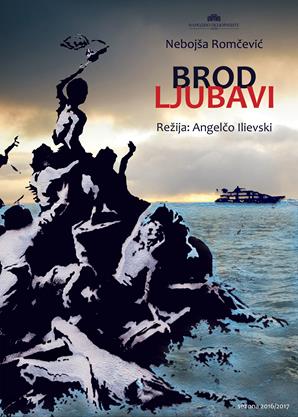
SHIP OF LOVE
drama
Nebojša Romčević
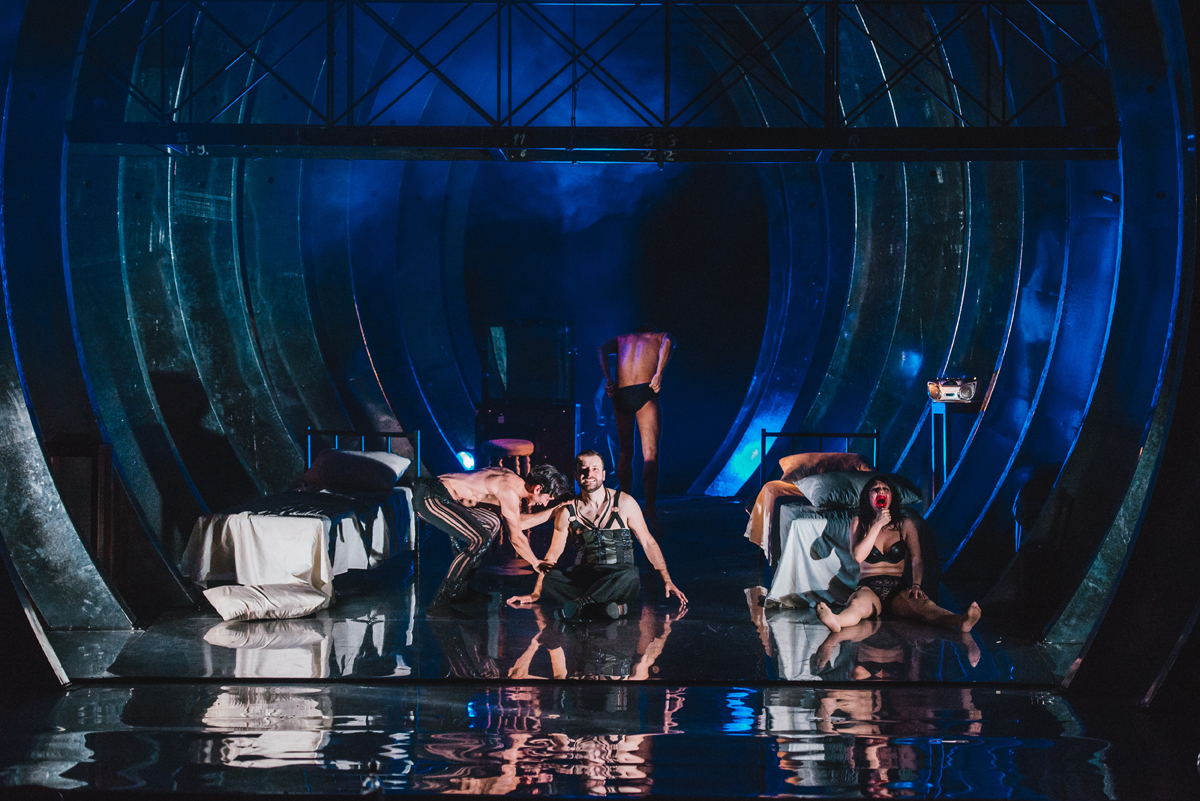
The Love Boat from the title of the play of the same name is actually the Kriemhild, a ferry sailing between Lübeck and Saint Petersburg. The passengers are, as the author puts it, “pigs from the East” and “assholes from the West”—sex workers from Eastern European (formerly communist) countries in search of money and a better life, and middle-class Europeans in search of pleasure, entertainment, or escape.
The latent conflict between these two worlds, rooted in economic power and the philosophy of liberal capitalism, intertwines pornography and politics, humor, violence, and the characters’ unfulfilled personal ambitions, yet ultimately gives way to the tragic fate of the individual. This is a story about the spiritual, moral, material, ideological, and psychological collapse of a world, told through the story of the disintegration of a human being.
DIRECTOR’S BIOGRAPHY
Angelcho Ilievski, a young Macedonian director, graduated in Theatre Directing from the Faculty of Dramatic Arts in Skopje, studying under Full Professor Slobodan Unkovski and Associate Professor Zlatko Slavenski. His home theatre, where he works as a director, is the National Theatre in Bitola.
His directing credits include: The Sower of Children (based on his own text), The Lesson by Eugène Ionesco, The Seducer (his own text), Steps by Samuel Beckett, The Ghost Sonata by August Strindberg, The Censor by Antonio Nilsson, Family Stories by Biljana Srbljanović, Sonnets by William Shakespeare (all produced in Macedonia), Who the Hell Started It First? by Dejan Dukovski in Osijek, Croatia, and Where Has Harms Gone? by Mila Mashović Nikolić at the National Theatre in Niš. He was assistant director on The Lost Germans by Dejan Dukovski, directed by Slobodan Unkovski, and The Master and Margarita by Mikhail Bulgakov, directed by Ivan Popovski. He is the author of three plays: The Sower of Children, The Seducer, and Where Is Your Place, Joey? (a play for children), as well as two poetry collections, On the Road to the Sun and Memories.
He has participated in numerous workshops in Macedonia and abroad. His production The Sower of Children won the Grand Prix for Best Production at two festivals, while Ilievski received an award for Best Direction. At several festivals in Macedonia and abroad, actors from his productions have received awards and recognition.
DIRECTOR’S NOTE
Nebojša Romčević’s play Love Boat was both a challenge and a pleasure for me. The text is complex in its own way; at first glance, it may seem superficial and simple, but in fact it opens up fundamental inner problems of the individual and society.
Both the play and the production deal with the spirit and state of our time. They speak of a collective madness that is very much a consequence of social pressure, all of which leads to a global collapse—the collapse of the human soul and of society as a whole.
I used the film screenplay and the original dramatic text and adapted them in order to create a cohesive overall story and develop all the characters and their relationships. The title of the production is Love Boat, yet in essence there is not a “gram” of love in it, and this irony is a reflection of the world today.
“If I stop dreaming, everything will cease to exist.” These characters lack dreams, they lack love, they lack life in the true sense of the word. They are alienated, living imposed lives, according to imposed rules, trapped in the machinery of a system that grinds them down and makes them uniform.
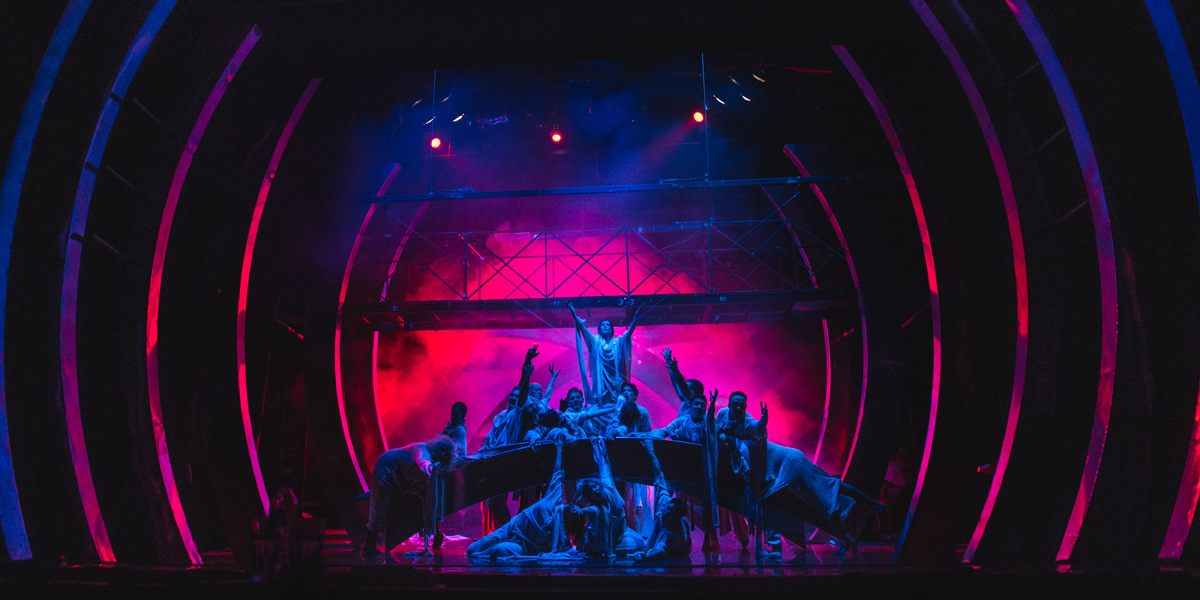
Essentially, the production deals with great problems through the lives of ordinary people who become lost in a vast world. The ship, as a metaphor for the world, offers glamour, splendor, happiness, love—all the things we lack. Yet in reality, it is all a false image that we desperately believe in.
The first line in the play—“We are like Noah’s Ark, wild beasts created by God for His own shame or amusement”—is, in fact, the definition of this text and this production. The ship as an escape from reality, the ship as salvation, the ship as a flight in search of what we desperately lack, no matter how false it may be.
This production is our deep and sincere cry, an attempt to show where this way of life is taking us. I think, and deeply believe, that we have succeeded.
I wish this production a long life, because it deserves it.
Angelcho Ilievski, Director
NEBOJŠA GROMILIĆ
Born in 1980 in Belgrade. He began his professional career at the Terazije Theatre, where he continues to work as a performer and choreographer. In 2010, he received a scholarship to attend the prestigious Jacobs Pillow school in the United States, where he trained in Musical Theater.
As a choreographer, he has staged more than 40 productions in Belgrade and throughout Serbia. At the “Vuk Stefanović Karadžić” Cultural Institution, he works as a musical theatre instructor at the Musical Theatre “Bulevar 77” school.
MARIJA PUPUČEVSKA
Born in Bitola. She graduated in Textile Design in Skopje. Since 2000, she has been employed at the Macedonian Opera and Ballet as Head of the Costume Design Department. She has worked on opera, ballet and drama productions in all Macedonian theatres, as well as in Serbia, Albania and Bulgaria.
She has received awards twice at the “Vojdan Černodrinski” Festival in Prilep, and is also a recipient of an award at the “Joakim Vujić” Festival in Kragujevac.
She is the author of the independent project “So Oblekuvanje”.
VALENTIN SVETOZAREV
Born in Bitola in 1963. He graduated from the Faculty of Architecture in 1987 and became the first scholarship recipient of the renowned Turkish architect Cengiz Bektaş. Since 1988, he has worked as a set designer or technical director in various theatres and on numerous projects – the National Theatre in Bitola, the Macedonian National Theatre, “Ohrid Summer”, and the V. F. Komissarzhevskaya Theatre in St. Petersburg. As an architect, he has designed major international trade fairs (the Tobacco Fair in Hong Kong, the Energy Fair in Barcelona) and museum exhibitions (the Dostoevsky Museum in St. Petersburg, the Museum of the Macedonian Revolutionary Struggle, the Museum of the Victims of Communism, the VMRO Museum, and the Archaeological Museum in Skopje).
He is the author of more than 250 set designs, around twenty of which were created in St. Petersburg, Moscow, Yekaterinburg and Kazan. He has received numerous awards – he has been awarded fourteen times at the “Vojdan Černodrinski” Festival in Prilep, twice at the European Actors’ Festival in St. Petersburg, and is also the recipient of the City of St. Petersburg Award for Architecture, Culture and Theatre.
Since 2010, he has served as Director of the National Theatre in Bitola and the Bitola Shakespeare Festival.
When is this performance playing?
You can find all upcoming dates on the Repertoire page.
BASIC INFORMATION
Genre
Drama
Age
14+
Premiere
November 9, 2016
Stage
Main Stage
CREATIVE TEAM
Director
Angelčo Ilievski
Playwright
Nebojša Romčević
Set Designer
Valentin Svetozarev
Costume Designer
Marija Pupučevska
Music
Borivoje Mladenović
CAST
The Boss
Marjan Todorović
Nina
Maja Vukojević Cvetković
Jana
Maja Banković
Saša
Jelisaveta Karadžić
Jacek
Danilo Petrović
Vasile
Miloš Cvetković
Horst (Merchant)
Aleksandar Mihailović
Noah (Writer)
Dušan Matejić
Publisher
Bojan Veljović
Marijana
Sanja Krstović
Karl
Dejan Cicmilović
Hana
Snežana Petrović
Gerda
Jasminka Hodžić
Elke
Evgenija Stanković
Jorgos
Marko Pavlović
Young Man
Stefan Mladenović
Uncle
Dragoslav Savić
Marija
Ivona Stojkov
TECHNICAL TEAM
Head of Technical Department
Ljubiša Živković
Stage Manager
Vladislav Đorđević
Prompt
Aleksandra Vukov
Sound Engineer
Slobodan Ilić
Lighting Design
Dejan Cvetković, Dejan Mitić
Effects
Nemanja Pavlović
Stage Master
Slaviša Filipović
Set Crew
Marin Rajić, Radomir Pešić, Miodrag Đorđević, Radovan Živković, Dragan Dinić, Mića Lazarević, Srđan Kitanović
Props
Dragan Nikolić, Marko Đorđević
Wardrobe
Dušica Mladenović, Marko Dinić
Make-up and Wigs
Ljiljana Rašić, Marija Pešić, Ivana Lazarević
Tailoring
Vladimir Pekić, Marina Stevanović
Scenic Painting
Vladimir Krstić
Workshop
Bogoljub Đorđević, Branislav Nikolić, Goran Stanković, Dragan Perić
Procurement
Dobrila Marjanović, Zoran Denčić
Driver
Nebojša Šarčević