
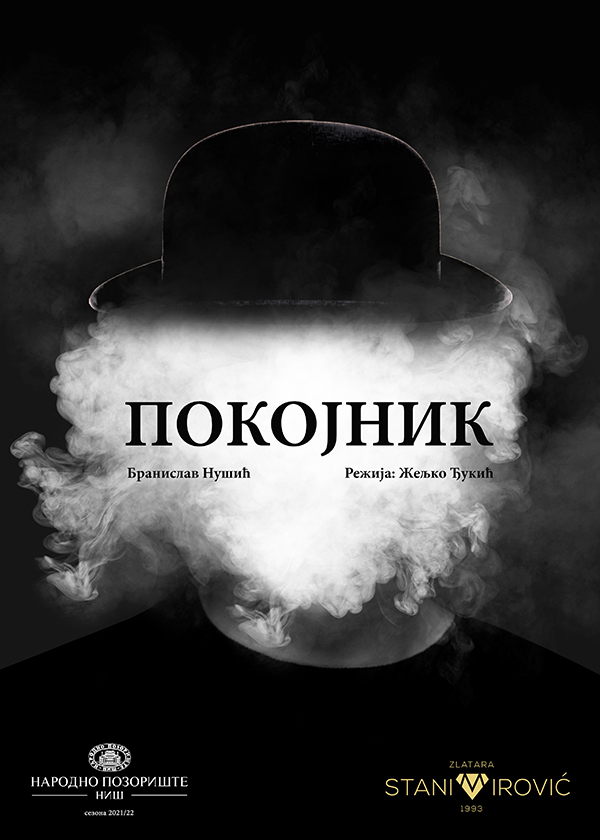
DECEASED
drama
Branislav Nušić
The Deceased is one of Nušić’s most significant satirical comedies, exposing the strong connection between capital and power. It presents a realistic portrayal of the origins of great wealth, flamboyant careerism, and the questionable value of certain doctoral titles. In the tragic capitulation of a dispossessed intellectual, it reveals a harsh truth about many authorities, both in the society of Nušić’s time and in the present day—authorities built on plunder, deception, dispossession, and perjury.
ABOUT THE AUTHOR
BRANISLAV NUŠIĆ – BIOGRAPHY
1864. On October 8, Branislav Nušić was born in Belgrade as the fourth child of the merchant Đorđe Nuša and his wife Ljubica, in a house located on the site of today’s National Bank of Serbia building on Kralja Petra Street. At his baptism, he was given the name Alkibijad.
1870. After going bankrupt, the father of young Alko, later known as Branislav, moved with his wife and five children to Smederevo.
1870–1874. He attended elementary school in Smederevo, where his father ran a business at the time.
1874–1882. He attended grammar school. In 1875, he repeated his first year of grammar school, briefly worked as an apprentice in Pančevo, and in 1876 continued his education at a grammar school in Belgrade, where he began his “life on the stage” with his cousin Jevta Ugričić.
1882. He graduated from grammar school and began signing his name as Branislav.
1883. He met Vojislav Ilić, who introduced him to the most prominent literary circle in Belgrade at the time. At the Ilić family home, he read his first work, The Member of Parliament.
1884. He studied law in Graz.
1885. He returned to Belgrade and continued his studies at the Grandes écoles. As a volunteer, he took part in the Serbo-Bulgarian War.
1886. He graduated in law from the Grandes écoles. He wrote The Stories of a Corporal.
1887. He published the poem The Funeral of Two Rascals, a criticism of the government of King Milan, for which he was sentenced to two years in prison.
1888. He spent a year in Požarevac Prison, where he wrote Patronage.
1889. After an audience with King Milan, he entered the diplomatic service. Over the next ten years, he served in consulates in Bitola, Pristina, Skopje, Thessaloniki and Serres.
1891. Together with Dragutin Ilić, he relaunched and edited the newspaper Preodnica.
1893. He married Darinka Đorđević, the daughter of the merchant Božidar. That same year, he was appointed consul in Pristina, where Vojislav Ilić served as his clerk.
1899. He became a member of the editorial board of Janko Veselinović’s Zvezda.
1900. He moved to Belgrade to become secretary of the Ministry of Education, then became dramaturge and acting manager of the National Theatre in Belgrade.
1901. He edited Theatre Journal.
1902. He retired at his own request after failing to be appointed manager of the National Theatre. That same year, he was reinstated and appointed commissioner of posts and telegraphs, a position he declined, and retired again. He participated in the founding of the Society of Serbian Writers and Artists.
1903. He was appointed head of the Department for National Propaganda within the Office of the Prime Minister. Following the May Coup, he was retired once again.
1904–1905. He served as manager of the Serbian National Theatre in Novi Sad.
1905. Together with Mihajlo Sretenović, he founded the Little Children’s Theatre in Belgrade.
1905–1910. He published his famous kozery—short humorous and satirical pieces—in Politika under the pseudonym Ben Akiba.
1906–1907. He served as deputy dramaturge at the National Theatre in Belgrade.
1907. He wrote a memorandum for Prince Nikola proposing the establishment of the Montenegrin National Theatre in Cetinje.
1908–1912. He worked as a journalist. He contributed to and edited the newspapers Samouprava, Tribuna, Beogradske novine, Dnevnik, Straža, as well as the humorous papers Brka, Ćosa, Satira, Telefon and others.
1910. He was sentenced to three months in prison for the article The People and the Dynasty. He did not serve the sentence because the wars began. He was awarded the Order of St. Sava and the Order of the White Eagle.
1912. He was appointed the first district chief of liberated Bitola.
1913. He organized a theatre in liberated Skopje and became its manager.
1915. In Skopje, his daughter Margita Gita married the writer Milivoje Predić. In the autumn, his son Strahinja Ban, a volunteer in the Bačka Company, was killed. Nušić retreated with the Serbian army through Albania to Corfu.
1916–1917. He lived in Italy, France and Switzerland. He wrote A Plan for the Reconstruction and Renewal of National Culture after the War.
1918. He returned to his post in Skopje.
1919. At the Ministry of Education in Belgrade, he served as the first head of the Department of Arts.
1922. Because of his play The Foundling, the Church excommunicated him.
1923. He was dismissed from his position as head of the Department of Arts. He was awarded the Order of St. Sava, First Class.
1924. The sixtieth anniversary of his birth and the fortieth anniversary of his literary career were celebrated.
1925–1928. He served as manager of the theatre in Sarajevo. For Ramadan Evenings, he wrote under the pseudonym Halil Delibašić.
1929. He became librarian of the National Assembly and finally retired. He was awarded the rank of Officer of the Legion of Honour.
1930. He participated in the film Paramount Revue in Vienna as an actor. He taught rhetoric at the Military Academy and wrote a textbook that remains in use to this day.
1931. He signed a contract with Geca Kon for the publication of his collected works.
1933. He became a member of the Serbian Royal Academy.
1934. After suffering his first serious illness, he went with his family to Hvar.
1935. Following the premiere of The Mourning Family in Sofia, he was awarded the Bulgarian Order of Civil Merit.
1936. He purchased a plot of land and built a house, which he moved into on September 15, at 1 Rozalija Morton Street (today Šekspirova Street).
1937. He underwent surgery at the Vračar Sanatorium in Belgrade. At the founding assembly of the Association of Artists, Scientists and Writers on December 5, he delivered his famous speech—an appeal against fascism, known as the Cultural Testament.
1938. Branislav Nušić died in Belgrade on Epiphany, January 19. He was buried in the family tomb at the New Cemetery.
DIRECTOR’S BIOGRAPHY
Željko Đukić graduated in directing from the Faculty of Dramatic Arts in Belgrade.
He lived in the United States for thirty years, where he completed his master’s studies and served as artistic director of The Utopian Theatre Asylum in Chicago. In addition to his home theatre, he directed productions in New York, Los Angeles, Washington, D.C., and Florida. His productions received numerous honors and awards, including the award for Best Production of the Season in Chicago for Uncle Vanya, the The Orgie Award for Artistic Vision, as well as several nominations for the prestigious Helen Hayes and Joseph Jefferson Awards.
In the former Yugoslavia and Serbia, he directed productions in Sarajevo and Mostar, while in Belgrade, at the National Theatre, he staged Home/Kabul in 2009.
After graduating, he worked at the Faculty of Dramatic Arts as an assistant in the Acting Department. In the United States, he continued his work in theatre education, teaching at several American universities, including the University of Illinois Chicago and Northwestern University. More recently, he has been working as an associate in the Acting Department at the Academy of Arts in Belgrade.
He was awarded a Fulbright Scholarship in 2013.
DIRECTOR’S NOTE
Instead of a “director’s note,” I had in mind an appropriate quotation from Nušić’s Autobiography, which best reflects the idea I followed while creating this production.
Branislav Nušić on Acting on Stage and Acting in Life
What is particularly pleasant about the acting profession is that an actor delivers his public speech, performs his work and fulfills his task while wearing a mask. Admittedly, everyone else in life does the same, but the difference between them and actors is that an actor puts on a real mask, a mask that corresponds to the role he is performing: he masks selfishness as selfishness, malice as malice, and spite as spite, whereas in life things are different: one role is played while another mask is worn. A politician, for example, puts the mask of a patriot over his selfishness; a violent man puts the mask of justice over his violence; a wealthy man puts the mask of charity over his usury; a promiscuous woman puts the mask of innocence over her experience, while a malicious person puts the mask of friendship over his advice.
The Deceased on the Niš Stage
Branislav Nušić, our timeless comedy writer, holds a special place as a playwright. “He is a true man of the theatre, more than anyone before him; he understands the art of the stage and knows the craft of theatre,” Jovan Skerlić once concluded, adding that throughout his prolific career he “was the favorite entertainer of the Serbian audience and, almost single-handedly, for a long time, filled the Serbian theatre.”
Looking back at the repertoire of the Niš stage from the very beginning of “Sinđelić” in 1887 to the present day, this is further supported by the fact that Nušić’s plays have been staged on the Niš theatre stage more than one hundred and twenty times.
Looking at Nušić’s body of work, one may conclude that toward the end of his life he returned to satire. Writing about Nušić’s The Deceased, Velibor Gligorić stated:
“While the threatening advance of fascism was taking shape on the horizon (…) Nušić had passed the age of seventy and had survived a serious illness from which he had barely recovered. It was in such an atmosphere that he wrote the comedy The Deceased. That is why it acquired the form of a combination of comedy and social drama, functioning both as drama and as comedy.”
Nušić himself said of the play that it “differs from the others through a more bluntly expressed tendency, through a certain sharper shading in its portrayal of our social circumstances.”
“This time, Nušić did not conceal social criticism and humor,” Gligorić wrote, “but came forward more openly and more forcefully to bring to the stage a fuller truth about the violence inflicted upon man in capitalist society. The power of authority has a broader social impact, this time directly aimed at a person’s freedom and existence. He is deprived of his rights as a citizen and to such an extent deprived of his rights as a human being that he is stripped of his identity, expelled from society, and expelled from life itself. A person who stands in the way of plans and interests must disappear from the face of the earth, either physically or spiritually. In this, the power of fascism over human existence and personality was also revealed.”
The first performance of The Deceased took place at the National Theatre in Belgrade in the autumn of 1937, and during the same 1937/38 season, it was also staged on the Niš stage of the then National Theatre of the Morava Banovina. By the end of 1941, when Hitler’s German boots were already trampling the newly opened theatre building’s stage, The Deceased, defying the advancing fascism, had been revived and staged four times.
In the post-war period, it was staged once, in September 1946, directed by Josif Srdanović, while the last premiere before the Niš audience took place in October 1987, directed by Petar Zec. In the 2021/22 season of the National Theatre in Niš, the seventh production of Nušić’s The Deceased was added to the theatre’s repertoire.
Tamara Milosavljević
Librarian, National Theatre in Niš
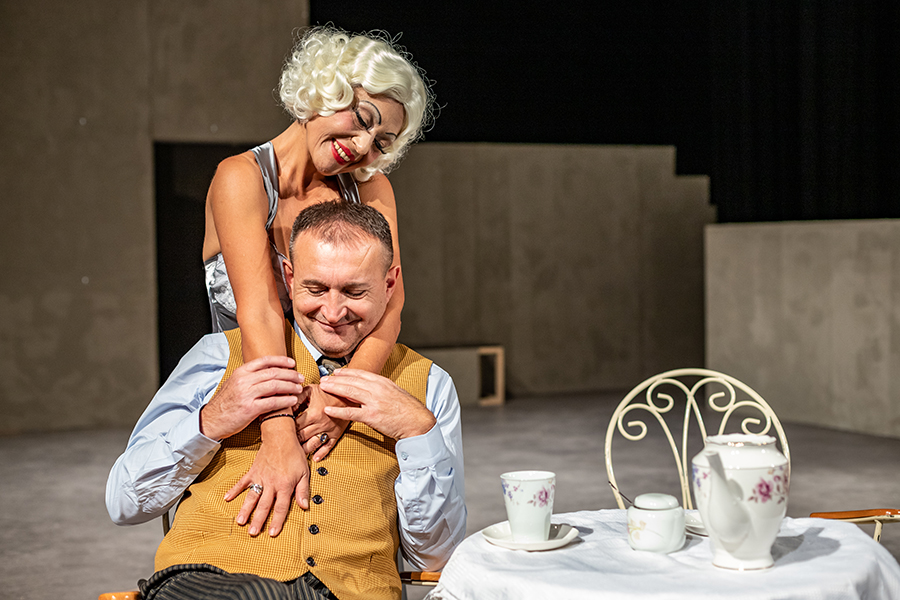
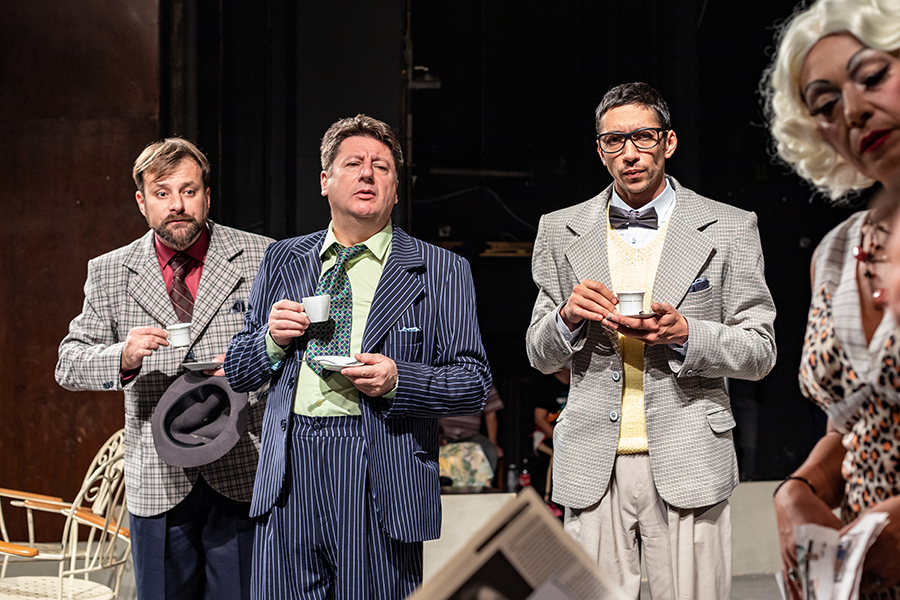
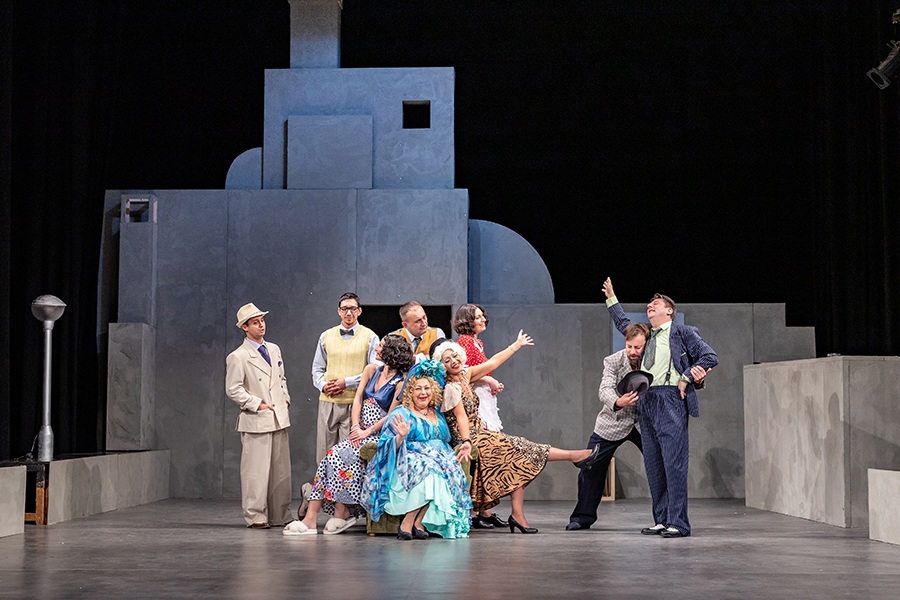
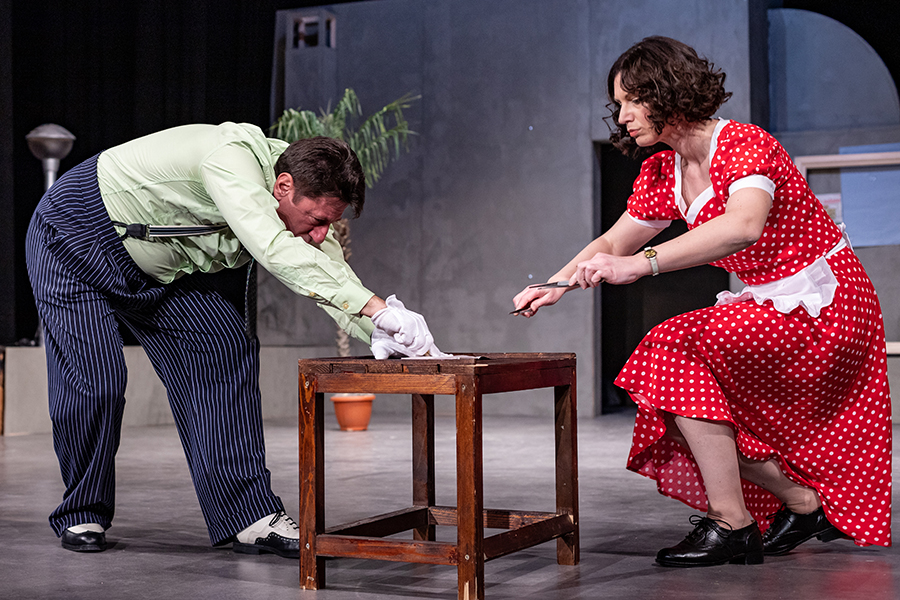
When is this performance playing?
You can find all upcoming dates on the Repertoire page.
BASIC INFORMATION
Genre
drama
Age
14+
Premiere
November 3, 2021
Stage
Main Stage
CREATIVE TEAM
Text
Branislav Nušić
Direction and Music Selection
Željko Đukić
Costume Designer
Nataša Vučurović Đukić
Assistant Costume Designer
Katarina Pavlović
Set Designer
Igor Vasiljev
Assistant Set Designer
Isidora Spasić
Music Selection Assistant
Branislav Dejanović
Language Editor
Nataša Ilić
Production Coordinator
Ivana Madić
CAST
Pavle Marić
Aleksandar Krstić
Milan Novaković
Miroslav Jović
Spasoje Blagojević
Aleksandar Mihailović
Mr. Đurić
Stefan Mladenović
Ljubomir
Miloš Cvetković
Anta
Danilo Petrović
Mladena Đaković
Maja Vukojević Cvetković
Rina
Sanja Krstović
Agnija
Jasminka Hodžić
Vukica
Katarina Arsić
Ana/Sofija
Katarina Mitić Pavlović
TECHNICAL TEAM
Stage Manager
Dobrila Marjanović
Prompt
Jana Savić
Sound Design
Slobodan Ilić
Lighting Design
David Jovanović, Vojkan Dobrosavljević and Nataša Vučurović Đukić
Technical Director
Dejan Mitić
Stage Manager
Slaviša Filipović
Set Crew
Srđan Kitanović, Miodrag Đorđević, Mića Lazarević, Dragan Dinić, Radomir Pešić
Props Master
Dragan Nikolić
Wardrobe
Dušica Mladenović, Marko Dinić
Make-up and Wig Designers
Ljiljana Rašić, Marija Cvetanović, Ivana Lazarević
Tailoring
Marina Stevanović, Vladimir Pekić
Milliner, Hat Making
Maja Studen
Workshop
Bogoljub Đorđević, Goran Stanković, Dragan Perić
Procurement
Zoran Denčić
Driver
Nebojša Šarčević